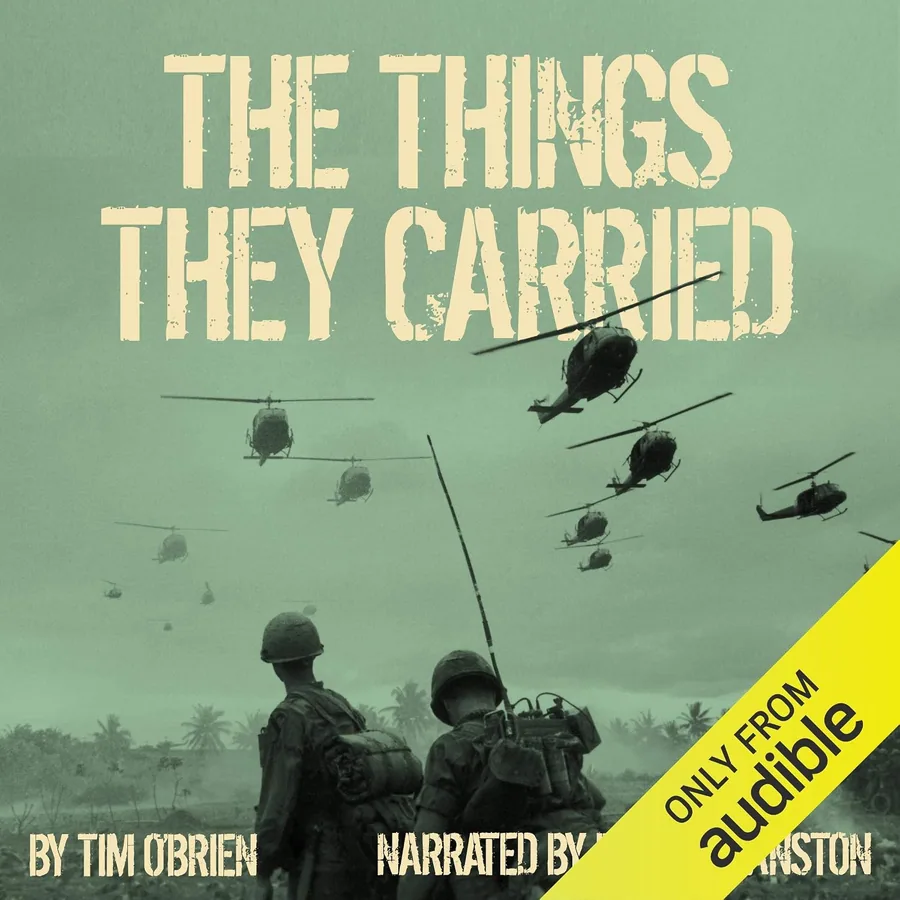
The famous opening list tells you almost everything about how this book works. The gear, the ammunition, the photographs, the unspoken fears each soldier hauls through the jungle. O'Brien builds emotional weight through accumulation. He keeps adding to the inventory until the physical objects start carrying psychological freight, and by the time he names the things that have no weight at all, you understand that the whole book is doing this trick. It's a structural move disguised as a catalog, and to my mind it's one of the most quietly devastating openings I've read in American fiction.
What makes this more than a war book is O'Brien's restless honesty about storytelling itself. There's a character named Tim O'Brien, a writer at forty-three with a daughter, who keeps circling back to the same events and telling them differently. The book draws a line between happening-truth and story-truth, then deliberately blurs it, insisting that a made-up detail can be more faithful to an experience than the verified facts. Readers who want a clear sense of what actually occurred will feel the ground shift under them on purpose. That instability is the point, and it's handled with so much tenderness that it never reads as a gimmick.
The prose is plain and clean, but O'Brien knows exactly when to let an image hold still. A man in a flooded field. A young Vietnamese soldier on a trail. The story of a girl who comes to the war and changes. These set pieces recur and echo, and the recurrence is where the grief lives. He's not interested in heroics or in tidy lessons about courage and cowardice. He keeps showing how blurry those words become under fire. The chapter about Norman Bowker after the war, driving in circles around a lake back home, may be the saddest thing here, and there's barely any action in it at all.
This works as a collection of stories and as a novel. The men reappear, the events rhyme, and the book gathers force as it goes. The tone moves from black humor to raw mourning, sometimes in the same paragraph. It shows up on countless syllabuses for good reason. It rewards close reading and discussion, but it never feels like an assignment. It moves.
Why you should read
- Readers drawn to literary war fiction that's more interior than action-driven
- Fans of linked story collections that build like a novel
- Anyone interested in metafiction and the slippery line between truth and storytelling
- Book clubs wanting rich material on memory, guilt, and grief
What to expect
- Readers who want a single linear plot may find the looping, fragmented structure disorienting, since the book keeps revisiting the same events rather than moving forward
- Some readers may feel the repeated commentary on the nature of truth and fiction grows insistent
If you come expecting straightforward, chronological war narrative or a single sustained plot, the fractured, looping structure is the thing to weigh hardest. It returns to the same ground again and again, refusing to settle, and some readers may find that disorienting rather than illuminating. A few may also feel the running commentary on truth and fiction grows insistent. But for anyone open to a book that questions how we tell our own lives, the payoff is large. This is a book for readers who care about memory, loss, and the strange mercy of stories, and it has stayed with me long after the last page.