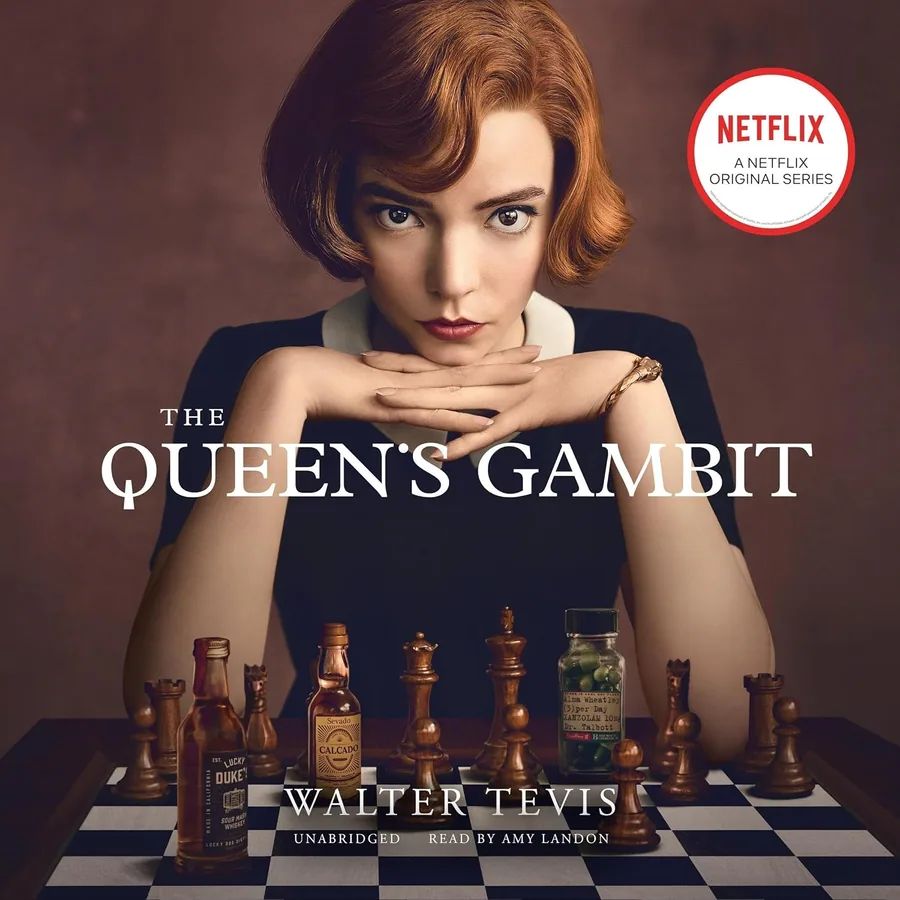
What got me first is how Tevis writes chess. He doesn't dumb it down or drown you in notation. He makes the board feel like the one room where Beth Harmon is completely herself, awake and in charge in a way she never is anywhere else. The prose tracks her mind so closely that I understood the pull of the game without being able to play a lick of it myself. That's the small miracle here: a quiet, interior activity carries more charge than most chase scenes I've read.
Beth is the engine. Orphaned young, watchful and closed-off, taught the moves by the orphanage janitor down in the basement, she grows into someone who treats losing as a personal humiliation. Tevis doesn't soften her. She's spiky and self-contained, often careless with the people who try to get close, and there were stretches where I wanted to shake her. But she's never dull, because we live inside her hunger. The addiction storyline isn't a lesson bolted on; it grows from the same root as her talent, the need to govern a world that took her parents and gave her nothing back.
The pacing is lean and keeps pushing forward. Tevis moves Beth tournament to tournament with the rhythm of a sports story, and that's both a strength and a limit. After a while the structure can feel a touch episodic, one match queued up behind the next, and the real drama lives less in who wins than in whether Beth can stay upright off the board. The looming proving ground in Russia hums under everything, a horizon she keeps moving toward, though I won't say how it lands. What sustains the book between matches is the way each opponent doubles as a mirror, showing Beth a little more of who she's becoming.
The prose stays clean and unshowy, which flatters the material. Tevis trusts the situations to carry the feeling instead of pumping them up. There's genuine warmth tucked under Beth's armor too, small loyalties and the slow realization that being singular doesn't have to mean being alone. One thing worth flagging: because we're locked so tightly inside Beth, the people around her can stay sketchy, more functions in her story than full lives of their own. If you want richly drawn supporting characters, you may notice them thinning at the edges. For readers who found this through the Netflix series, the book is the quieter, more interior version, and it earns its emotional payoffs precisely because it never begs for them.
Why you should read
- Readers who loved the Netflix adaptation and want the deeper interior version
- Fans of voice-driven coming-of-age fiction with a prickly, brilliant heroine
- Anyone drawn to stories about genius, obsession, and addiction
- Readers who like a sports-novel structure with literary depth
What to expect
- Close third-person narration that stays tightly inside Beth's guarded mind
- Quiet, controlled prose with tension that builds through restraint rather than spectacle
- A coming-of-age arc that spans childhood through young adulthood at a deliberate pace
- Emotional undercurrents that hit harder for being underplayed
This is voice-driven literary fiction that happens to move fast, and it sits comfortably alongside the best of that shelf. If you want a strong central character in an unusual world, written with real conviction and not an ounce of fat, it's a fine match.