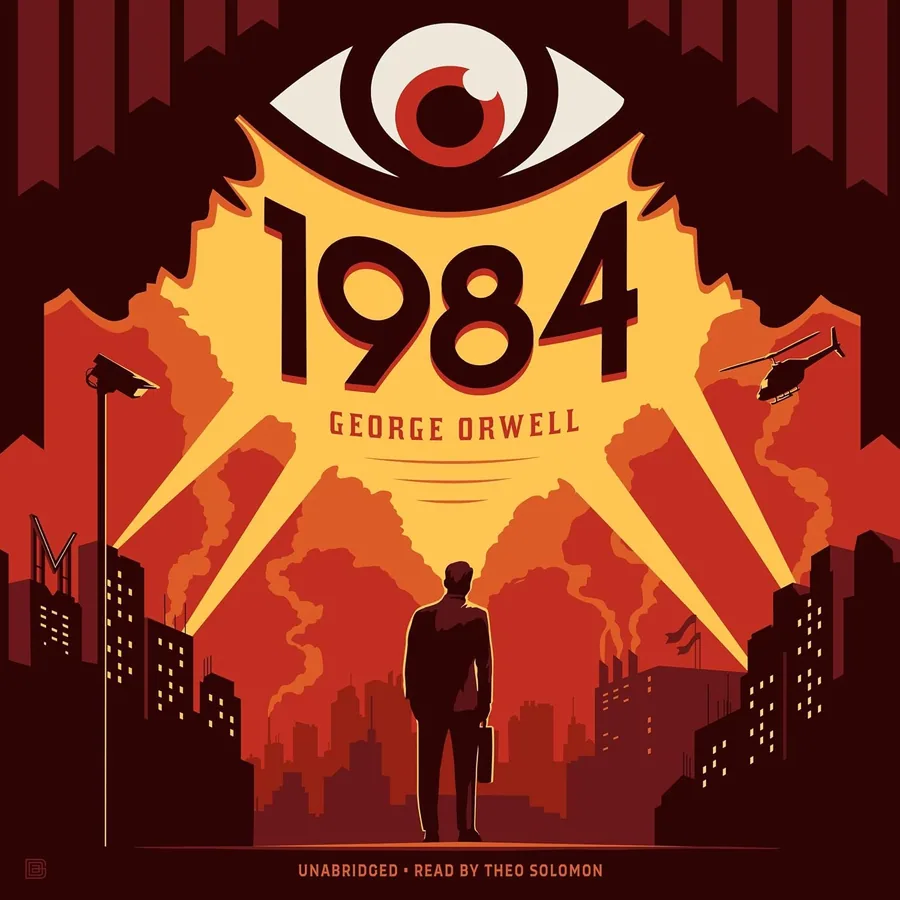
What makes 1984 endure isn't its gadgets. The telescreens and hidden microphones feel almost quaint now. It's the rigor of the internal logic. Orwell builds a society where the most dangerous act isn't violence but private memory. Winston Smith works at the Ministry of Truth rewriting the past to match the present, and the horror crept up on me slowly: if every record can be altered and no one remembers otherwise, what does it even mean to know something is true? The book treats this as a problem with rules and follows those rules to their cold conclusion. That's the worldbuilding move that lifts it above polemic.
The central invention is Newspeak, the engineered language designed to shrink the range of thinkable thoughts. It's a genuinely chilling idea executed with care. Orwell understands that controlling vocabulary is a way of controlling possibility. Concepts like doublethink, the capacity to hold two contradictory beliefs and accept both, do more dramatic work than any surveillance scene. These aren't decoration. They're the machinery of the plot, and they hold up under pressure, which is exactly what I read this kind of book for.
The story itself is leaner than its reputation suggests. Winston's quiet rebellion, his affair with Julia, and his reach toward an underground resistance give the ideas a human body to inhabit. The middle section, where the two of them carve out a stolen private life, caught me off guard with its tenderness given everything around it. Orwell knows precisely what he's doing by letting you hope. The final act turns relentless and claustrophobic. Where the book goes emotionally is downward, deliberately, and it earns that descent rather than wallowing in it.
The prose is plain and exact, built for clarity rather than beauty, though it lands hard images: a city of decay, gin that tastes of nothing, a single proletarian woman singing in a yard. There's a recurring attention to small physical objects too, a glass paperweight, a scrap of coral, that quietly carries the weight of everything Winston is trying to hold onto. Orwell embeds a long stretch of theoretical material, passages from a forbidden book within the book, that explains how the system actually works. Reviewers split sharply on this section. Some find it the thrilling moment the architecture gets laid bare. Others say it stalls the story into a lecture, and skim it. Both reactions show up again and again in the threads, and both are fair.
Why you should read
- Readers who love idea-driven dystopias with consistent internal rules
- Fans of speculative fiction that takes language and memory seriously as instruments of power
- Anyone wanting the foundational influence behind modern dystopian fiction
What to expect
- Readers who prefer brisk, plot-forward storytelling may find the long expository theory section in the middle reads more like an essay than a novel
- The tone is unrelentingly bleak by design, so those wanting hope or catharsis should know it heads steadily downward
More than seventy years on, 1984 reads less like a failed prediction and more like a working instrument for noticing how power distorts reality. Its influence on later dystopias is hard to overstate, and unlike many forebears it still holds its own against its descendants. If you want speculative fiction that argues seriously about truth, freedom, and the self, this is essential ground to stand on.