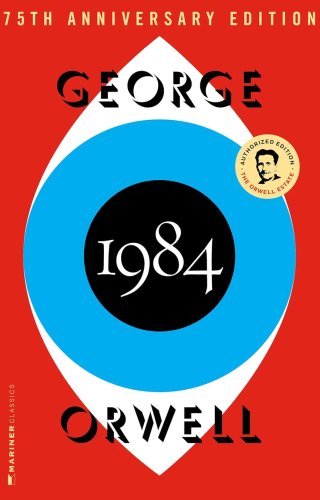
What makes 1984 permanent isn’t the technology — it’s the precision about how power rewrites truth, language, and finally love. If you want more fiction with that unsparing clarity, worlds where the system is the villain and thinking for yourself is the crime, these reviewed dystopian novels earn their place on the same shelf.
Hugh Howey's Wool traps its survivors inside a single buried silo, where the official story about the world outside is a lie the leadership polices with real teeth. Ask the wrong question about what's really out there, and you're sent to your death dressed up as a chore. It has the same DNA as Orwell's Ministry of Truth: a society run on controlled information and enforced belief, with one person's stubborn curiosity threatening to unravel it. Howey builds the paranoia slowly, then lets it detonate.
Orwell terrorized readers with boots and surveillance; Huxley scares them with comfort, a future where humans are grown to order and kept docile with drugs instead of fear. It's the philosophical mirror image of 1984's control-by-force, following the misfits who can't stop noticing the machinery humming underneath the pleasure.
Orwell's Oceania never gets overthrown from the inside; Pierce Brown imagines what it looks like when someone tries. A Martian miner goes undercover into the academy that trains humanity's ruling caste, using their own brutal games to bring the whole system down. It's faster and bloodier than Orwell, but the caste machinery underneath is just as merciless.
Ernest Cline imagines a future where escaping into a virtual world isn't rebellion, it's survival, and a corporation still owns the exits. The same instinct as Orwell's Party: control the culture people retreat into, and you control them.
Octavia Butler wrote this in the early '90s and set it in 2025, a California coming apart at the institutions Orwell worried about most: order, information, trust. Lauren Olamina walks north through the wreckage with nothing but a new belief system to hold onto. It reads less like fiction now than a forecast that came in on schedule.
A fireman whose job is burning books starts questioning why, after a curious teenage neighbor gets too close. Bradbury's regime keeps its citizens docile with comfort instead of terror, a quieter but no less total kind of control.
Margaret Atwood swaps Big Brother for unchecked corporate power, following possibly the last man alive as he narrates how the world ended from a tree. It's satire with real teeth, tracing how a small elite convinced everyone else that catastrophe was progress. If Orwell's fear was who controls the story, Atwood's is who controls the science, and neither one ends well.
Asimov's 1951 classic imagines a mathematician who can predict the fall of a galactic empire centuries in advance, then asks whether knowing the future changes anything about surviving it. It shares Orwell's fascination with systems too large for any one person to fight, but where 1984 watches power crush the individual, Foundation studies how the individual might out-think the empire's whole trajectory instead.
As an Amazon Associate, we earn from qualifying purchases. This helps support the site at no extra cost to you.
Common questions
Finding your next read
What makes these books similar to 1984?
The strongest shared threads are surveillance, totalitarianism, propaganda, control, rebellion, truth, freedom. Each recommendation is chosen for a specific overlap in tone, theme, character, or reading experience rather than genre alone.
Are all of these books reviewed?
Yes. Every recommendation links to a complete Book of the Day review with our score, verdict, and guidance on who will enjoy it.