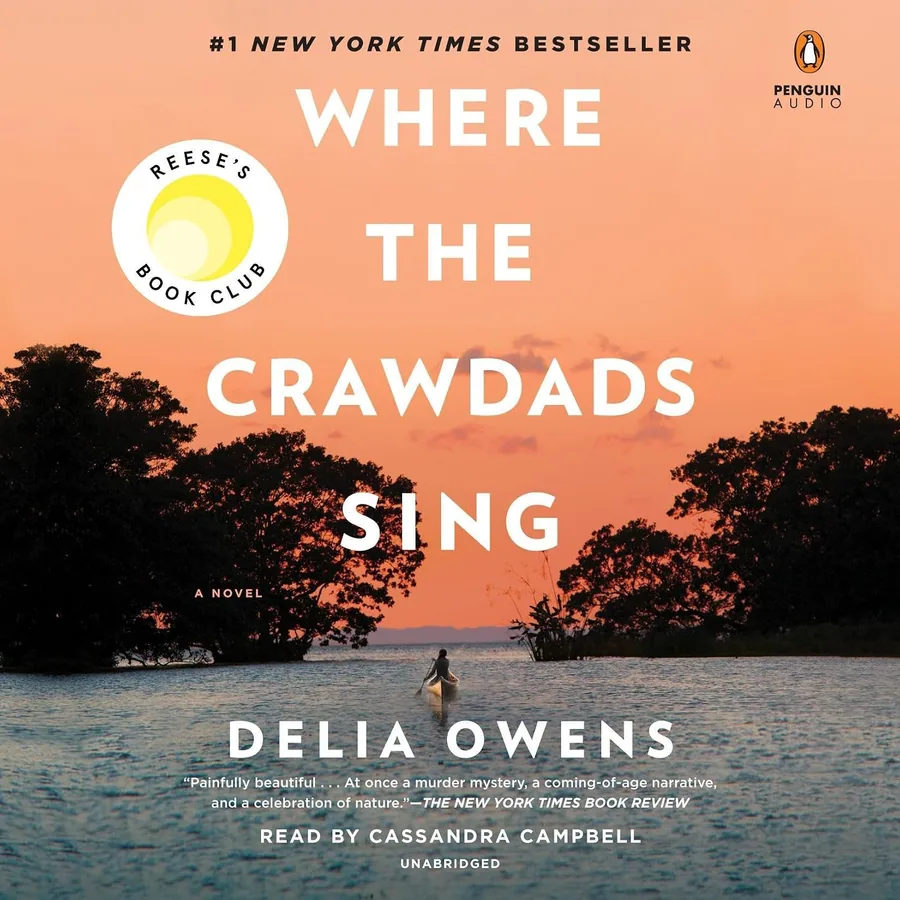
The real achievement here is Kya. Owens builds her from the ground up — a small girl watching one family member after another walk down the lane and not come back, learning to read the marsh before she learns to read words. What could have been a misery story becomes something stranger and more resilient. Kya teaches herself the rhythms of tides and gulls and feathers, and Owens lets that self-education carry real emotional weight. By the time Kya yearns for human touch, you understand exactly how high the stakes are for someone who has been taught that people leave.
The prose leans lush, and that's the book's signature. Owens is a wildlife scientist, and it shows in the way she renders the marsh — the heron's patience, the smell of mud, the color of the water at different hours. Some readers will sink happily into that sensory writing; it's the engine of the book's mood. The natural world isn't backdrop here. It's character, comfort, classroom, and at times a kind of moral logic, since Kya keeps returning to what animals do to make sense of what people do.
Structurally, Owens runs two timelines that tighten toward each other. One follows Kya's childhood and young adulthood as two town boys take an interest in the so-called Marsh Girl. The other opens in 1969 with a body and the question of who killed Chase Andrews. The alternation gives the book its pull — you read the past wondering how it bends toward that death, and the courtroom chapters keep the present taut. It's a quieter mystery than a thriller, more concerned with prejudice and isolation than with forensic surprise, though it does deliver a final turn. The two boys, Tate and Chase, are drawn with real difference — one patient and bookish, one careless and entitled — and the way Kya measures them tells you how much she's had to teach herself about trust.
What lingers is the theme of being marked by where and how you were raised. The town decides who Kya is before she can speak for herself, and the novel is sharp about how loneliness and class and rumor harden into a verdict long before any trial. There's a tenderness running underneath all of it — the idea that a child shaped by abandonment is still, against the odds, capable of love, art, and survival. Owens threads poems and the slow accrual of Kya's drawings and shell collections through the years, so the book also becomes a record of one person making meaning out of solitude. That's the emotional core that has moved so many readers, and it earns the response.
Why you should read
- Readers who love atmospheric, place-driven fiction
- Coming-of-age stories about survival and self-reliance
- Book clubs wanting a discussable mix of literary fiction and mystery
- Fans of nature writing woven into narrative
What to expect
- Readers who want a fast, twist-heavy thriller may find the mystery secondary and the pacing slow in the marsh-soaked middle stretches
- Some readers find Kya's self-taught accomplishments and the romance a touch idealized; if you prefer grittier realism, that may register
This is a book for people who want atmosphere and feeling over breakneck plotting, and who don't mind a story that occasionally tips toward the lyrical and the idealized. Read it slowly, the way it wants to be read, and the marsh gets under your skin.