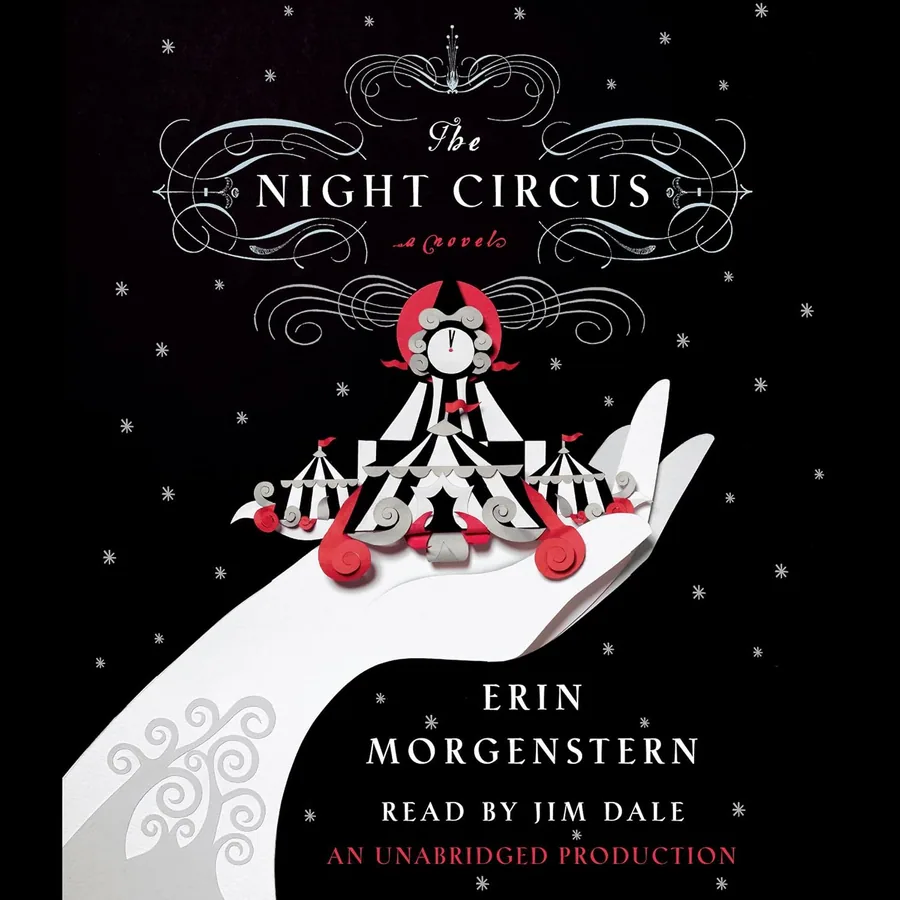
The premise sounds straightforward. A circus appears overnight, throws open its gates only when the sun goes down, and inside its striped tents two young illusionists carry out a quiet duel neither fully grasps. But the contest between Celia and Marco isn't really what drives the book. The circus itself is. Morgenstern renders Le Cirque des Rêves with such tactile devotion that it becomes the most fully drawn character on the page, each tent its own small act of invention, the bonfire at the center pulsing like a heartbeat. I'll admit I stopped trying to track the rules of the game about a hundred pages in and just let myself wander the grounds, and the book improved the moment I did.
Morgenstern writes in a hushed, present-tense voice that pulls you inside the experience rather than narrating it from a distance. The prose leans hard into texture, scent, candlelight, the cold air outside a tent. That commitment to mood is both the book's greatest pleasure and its main risk. The love story between Celia and Marco grows almost entirely by indirection. They build wonders for each other inside the circus instead of speaking their feelings aloud, and the romance lives in those gifts. I found it genuinely moving. I can also see a reader wanting them to just say something out loud for once.
Underneath the spectacle there's a real ache. The book is preoccupied with the cost of being shaped for someone else's purpose. Both Celia and Marco are raised as instruments by mentors who treat them as evidence in a long-running argument, and the deadly stakes of their contest register less as suspense than as a slow dread, the way you dread the end of a night you don't want to leave. Fate versus choice runs through everything, and so does the question of what people will sacrifice to protect something fragile they made together.
The timeline is the book's boldest gamble, moving back and forth across years rather than marching forward. For me it mostly worked, though there were stretches in the middle where I felt the story circling rather than advancing. This is where I'd be honest with the wrong reader: if you need momentum, a clear throughline, a sense of building toward something, the drift here can genuinely frustrate. Morgenstern chooses mood over forward motion almost every time, and she leaves the rules of the contest deliberately hazy. That haziness reads as atmosphere to some of us and as evasion to others. It's a fair criticism, not one I'd wave away.
Why you should read
- Readers who prize atmosphere, sensory detail, and dreamlike world-building over fast plotting
- Fans of slow-burn, understated romance built on gesture rather than declaration
- Anyone who loved the immersive mood of Morgenstern's later novel The Starless Sea
- Book clubs that enjoy discussing fate, free will, and the price of devotion
What to expect
- Readers who want a tight, fast-moving plot may find the nonlinear timeline and the deliberately vague rules of the contest slow or under-explained, especially through the middle stretches
- The romance unfolds quietly and by suggestion; those who want heat or scene-by-scene relationship development may wish for more on the page
What stayed with me afterward wasn't the resolution. It was the sensory residue, the smell of caramel and woodsmoke, the quiet of a tent past midnight, the conviction that wonder is worth the danger it carries. I read most of it across two long evenings, which felt right. This is a book to enter slowly, when you have time to roam.