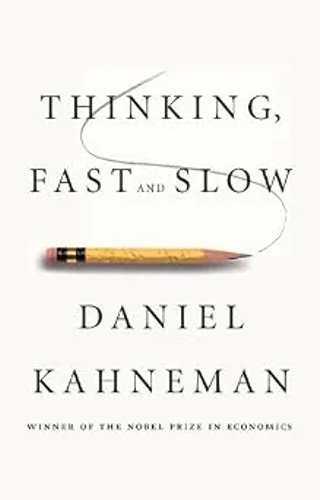
Starting point — pull a thread

Books Like Thinking, Fast and Slow: How Minds Actually Work

If you loved Thinking, Fast and Slow by Daniel Kahneman.

Kahneman’s masterwork is the rare book that hands you a new pair of eyes: once you’ve seen System 1 and System 2 at work, you can’t unsee them — in markets, in headlines, in your own bad calls. If you want more rigorous, readable science of how we think and choose, these reviewed books keep the lights on.

Why these match

  • decision making
  • bias
  • behavior
  • rationality
  • the brain
  • judgment
  • economics

Quick answer

What should you read after Thinking, Fast and Slow?

Start with The Power of Habit: Why We Do What We Do in Life and Business, Noise: A Flaw in Human Judgment, or Range: Why Generalists Triumph in a Specialized World. They are the closest matches in our reviewed catalog; the full list below explains where each recommendation overlaps and where it goes its own way.

Updated August 2026

Cover of The Power of Habit: Why We Do What We Do in Life and Business by Charles Duhigg

Pick 01 · Top match

The Power of Habit: Why We Do What We Do in Life and Business

by Charles Duhigg

4.7/ 5Outstanding

Charles Duhigg picks up where Kahneman leaves off, trading System 1 and System 2 for the cue-routine-reward loop that quietly runs mornings, companies, and even civil-rights movements. It's behavioral science with the same rigor Kahneman fans expect, but built around stories instead of studies, which makes it move fast. If Thinking, Fast and Slow taught you to notice your own bad calls, The Power of Habit shows you the machinery underneath the habits that produce them.

Advertisement

On the shelf

Cover of Range: Why Generalists Triumph in a Specialized World by David Epstein

Pick 03

Range: Why Generalists Triumph in a Specialized World

by David Epstein

4.6/ 5Outstanding

David Epstein takes Kahneman's skepticism about how the mind reasons under uncertainty and applies it to career advice, arguing that generalists who sample widely often out-think the specialists who committed early. It's a smart, well-reported answer to the same over-simple certainty Kahneman spent his career complicating.

Cover of Tools of Titans: The Tactics, Routines, and Habits of Billionaires, Icons, and World-Class Performers by Timothy Ferriss

Pick 08

Tools of Titans: The Tactics, Routines, and Habits of Billionaires, Icons, and World-Class Performers

by Timothy Ferriss

Nearly two hundred high performers, distilled into routines and tactics you can actually test against your own life. Where Kahneman explains how the mind misfires, Ferriss hands you a menu of habits for outsmarting it, no single guru required.

Cover of The Gifts of Imperfection: Let Go of Who You Think You're Supposed to Be and Embrace Who You Are by Brené Brown

Pick 09

The Gifts of Imperfection: Let Go of Who You Think You're Supposed to Be and Embrace Who You Are

by Brené Brown

4.8/ 5Incredible

Brene Brown swaps Kahneman's research-heavy argument for something closer to a workbook, ten guideposts for living without the constant performance of having it together. If Thinking, Fast and Slow convinced you how much of your own thinking runs on autopilot, this gives you a daily practice for interrupting it rather than another study to read about it.

Cover of Be Your Own Bestie: A No-Nonsense Guide to Changing the Way You Treat Yourself by Misha Brown

Pick 10

Be Your Own Bestie: A No-Nonsense Guide to Changing the Way You Treat Yourself

by Misha Brown

4.7/ 5Outstanding

Kahneman mapped the two systems running your brain; Misha Brown goes after the one habit most people never fix, the running commentary they'd never let a friend get away with saying to them. Be Your Own Bestie turns a viral social voice into a four-step method for catching that self-talk in the act, a warmer, more workable companion to the cognitive science for anyone who read Kahneman and still can't quiet their own head.

As an Amazon Associate we earn from qualifying purchases. The price you pay is the same; the commission helps keep the lights on.

Common questions

Finding your next read

What makes these books similar to Thinking, Fast and Slow?
The strongest shared threads are decision making, bias, behavior, rationality, the brain, judgment, economics. Each recommendation is chosen for a specific overlap in tone, theme, character, or reading experience rather than genre alone.
Are all of these books reviewed?
Yes. Every recommendation links to a complete Book of the Day review with our score, verdict, and guidance on who will enjoy it.

Keep exploring

More read-alike lists

Still hunting for your next read? Browse every read-alike list →