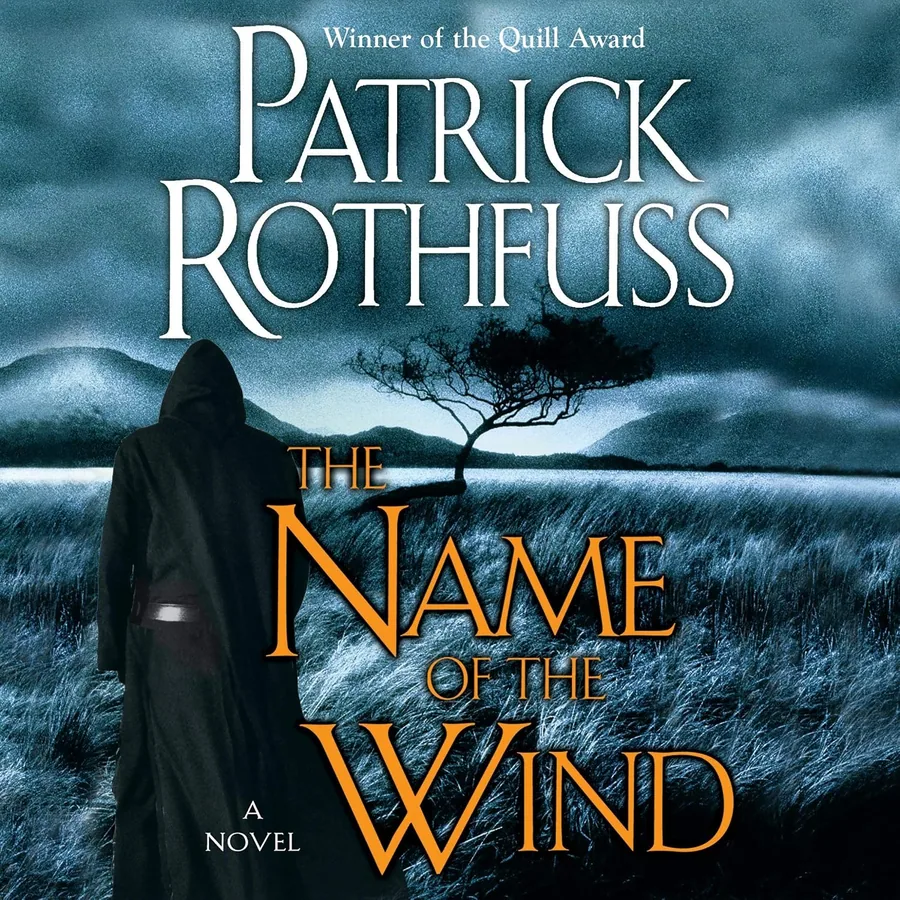
There's a particular pleasure in watching a fantasy writer who actually means it about craft, and Rothfuss means it. The Name of the Wind frames its whole story around an innkeeper in a quiet, dangerous backwater who turns out to be the famous Kvothe — adventurer, arcanist, kingkiller — agreeing to dictate his true history to a chronicler over three days. So the bulk of the book is Kvothe narrating his own youth: a clever, prickly, grief-shaped boy growing from a troupe of traveling performers into a beggar on hostile city streets and finally into a student at the University. The framing matters more than it first appears. We're always aware we're hearing a polished version told by the man himself, which lets Rothfuss play with the distance between what really happened and what becomes legend.
The worldbuilding is the kind I read this genre for: rules with teeth. Magic here, called sympathy, runs on something close to a physics of energy and belief — you bind two things together, you pay an honest cost, and overreach can cook your own mind or body. Then there's naming, the older and stranger art of knowing a thing's true name well enough to command it, and the wind in the title is exactly the prize Kvothe chases. The University itself is a wonderful invention: a medieval institution with tuition you must barter for, a punitive whipping post, an artificiary that's basically an industrial workshop, and an underworld archive called the Archives that any book-lover will ache to wander. The economy is real. Kvothe is always broke, and the tension of where his next term's tuition comes from drives more suspense than most sword fights.
What ties it together is music and language. Rothfuss writes Kvothe's relationship to the lute as something physical and devotional, and the prose itself has a measured, slightly formal music that suits a story being performed aloud. The sentences are clean and rhythmic without showing off, and the best scenes — a lute audition before a hostile crowd, a confrontation with an arrogant professor, a slow-burning courtship with a girl named Denna who's always one step out of reach — earn their emotion through patience rather than spectacle. This is a book that trusts small stakes. A few coins, a borrowed instrument, an admission to a class can carry as much weight as any battle.
It's worth being honest about the shape of the thing. This is a leisurely, immersive novel that prioritizes texture, character, and the slow accumulation of a life over relentless forward momentum. Big mythic threats — the nightmarish Chandrian who haunt Kvothe's past, the larger mystery the frame is circling — are seeded and savored rather than resolved. Readers who want a self-contained plot that lands every payoff in one volume should know this is the opening movement of a longer work, and the series remains unfinished. But on its own terms it's remarkably complete: a portrait of a gifted, arrogant, lonely young man, and a meditation on how stories get made and what they cost the person at their center.
Why you should read
- Readers who love magic-school settings with real rules and real costs
- Fans of Le Guin's Earthsea and naming-magic traditions
- Anyone who prizes prose, music, and slow-burn character over fast plotting
- Readers who enjoy unreliable narrators and the legend-versus-reality theme
What to expect
- Lyrical, deliberate prose — this is not a fast-paced action-first fantasy
- A nested storytelling structure that keeps you aware of the distance between legend and truth
- A coming-of-age arc that moves through grief, survival, and intellectual hunger
- Rich world-building revealed gradually through experience rather than exposition dumps
- An ending that feels intentional but incomplete — this is book one of a trilogy
If you came up loving Le Guin's Earthsea for its naming-magic and moral weight, or you want a magic school written for adults with genuine intellectual stakes, this is close to ideal. It rewards patient readers and re-readers, the kind who notice the small inconsistencies between Kvothe's boasts and his confessions. Glowing as I am, I'd point newcomers here first if they care about voice, internal logic, and the feeling of a world that keeps going past the edges of the page.