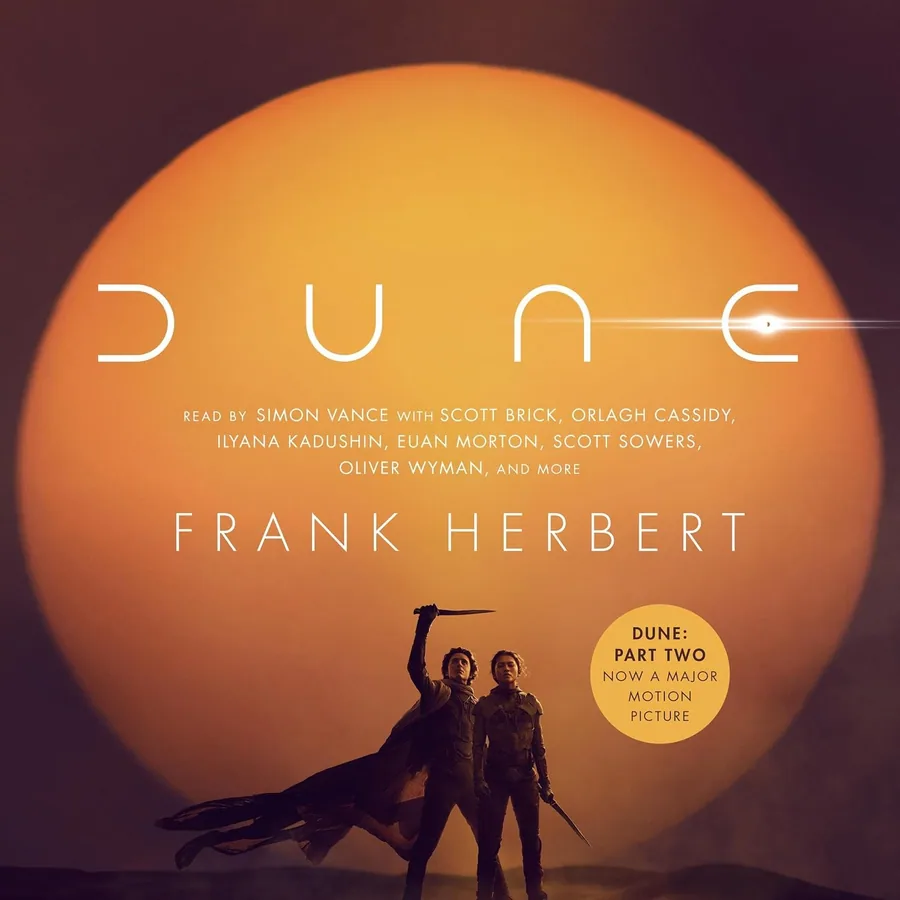
I bounced off Dune twice in my twenties before it finally took. Both times I quit somewhere in the early political maneuvering, impatient for the desert and the worms everyone had promised me. The third time I slowed down to match Herbert's pace instead of fighting it, and the whole thing opened up. That's the book in miniature: it asks you to live inside its rhythms rather than skim them, and it pays you back generously once you do.
What makes Dune endure isn't the swordfights or the sandworms, though both deliver. It's that Herbert built a world where every piece locks into every other piece. Arrakis is a planet where moisture is hoarded, where the native Fremen reclaim the water from their own dead, where an entire culture's customs grow logically out of scarcity. That consistency is the book's secret engine. When Paul Atreides arrives with his family to take stewardship of the spice trade, you understand instantly why this barren rock is the most contested prize in the empire, and the stakes feel earned rather than asserted.
The story tracks Paul from sheltered heir to a figure he himself can barely stand to look at, and Herbert is patient about the transformation. Early chapters move through politics, training, and quiet menace before the desert claims the narrative. This is deliberate. Herbert wants you to feel the slow tightening of a trap, the sense that everyone is playing a game several moves deep. He also does a daring thing with point of view, slipping into multiple characters' inner calculations, even villains', so you watch schemes collide with full knowledge of both sides. It ought to puncture the tension. Instead it builds dread, because you see the blade coming and the characters don't.
The ideas carry the weight here. Ecology runs through the whole book as a serious subject, not set dressing, complete with a planetary scientist whose dream of a green Arrakis becomes one of the quietest, most moving threads. Religion and prophecy get treated without sentiment: Herbert is fascinated by how belief gets manufactured and weaponized, and by what it costs a person to become the messiah other people need. Power, drugs, genetics, the seductiveness of a charismatic leader, all of it gets folded into the plot rather than lectured at you. Few science fiction novels carry this much thought without sagging under it.
Why you should read
- Readers who love deep, rule-bound worldbuilding over quick action
- Fans of political intrigue, ecology, and ideas-driven science fiction
- Anyone wanting the epic that shaped modern space opera
- Readers who enjoy slow-building dread and morally complex leaders
What to expect
- Deliberate, measured pacing that rewards attention rather than speed-reading
- A dense opening that gives way to an increasingly propulsive narrative
- Shifting perspectives that reveal how differently each character reads the same events
- Prose that is formal and precise, with an almost mythological register
- Moments of sudden, visceral action that land harder for the quiet surrounding them
Herbert's prose is dense and a little formal, full of invented terms, italicized interior thoughts, and epigraphs that open each chapter with fragments of future history. The effect is immersive once you settle in, like learning a language by living in the country rather than studying a glossary. The desert itself becomes a character, with its own rhythms of heat, stillsuits, and the seismic approach of the worms. By the time Paul rides what the Fremen call the maker, the payoff lands because you've spent hundreds of pages understanding exactly what that moment costs and means. Dune is often credited as the book that taught science fiction to take worldbuilding seriously, and reading it now, that reputation feels deserved. For my money it still reads as ambitious rather than dated, and it remains one of the few epics where the journey genuinely earns its destination.