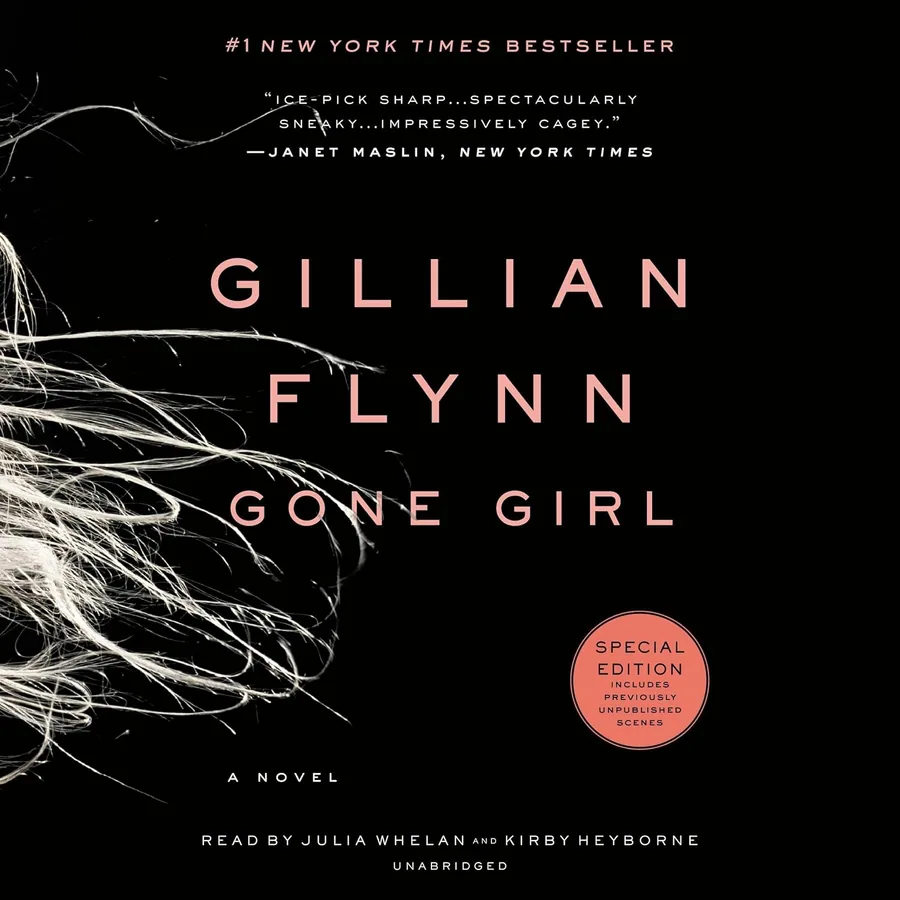
On the morning of their fifth anniversary, Amy Dunne vanishes from the home she shares with Nick in a hollowed-out Missouri river town. That's the premise, and Flynn knows you've seen the husband-did-it setup before, so she splits the storytelling between two voices. Nick narrates the present-day investigation while Amy speaks through diary entries that wind backward through the courtship and the slow rot of the marriage. The early chapters get their charge from the friction between those accounts. I caught myself flipping back to compare timelines, deciding which version sounded more honest, and Flynn lets you feel clever right up until she pulls the rug out.
The structural pivot is what people remember. There's a moment around the halfway mark that resets your understanding of nearly everything before it, and to my reading the groundwork was there the whole time, hiding in plain sight rather than cheating. What impressed me most is how Flynn turns voice into evidence. Both narrators are funny, watchful, and fluent in self-justification, so you start reading sentences for what they're concealing. Her idea of the 'cool girl,' as I'd describe it, the woman who reshapes herself into whatever the man beside her wants, anchors the book's real subject: the selves we build for an audience, and what happens when the audience is your spouse.
As a thriller, the pacing is deliberate rather than breathless, which won't suit everyone. The first half simmers, building dread through small wrongness. A husband smiles at the wrong moment. A daydream curdles. The back half turns colder and more controlled, less about whodunit than about watching two formidable minds maneuver, and a few stretches there felt more clinical than tense to me. Flynn also has sharp things to say about how the media frames a vanished, photogenic woman as a story to be consumed, and how public sympathy gets manufactured. That observation gives the book teeth beyond its plot.
The ending is where readers genuinely divide, and it's worth naming. Scroll the reviews and you'll find plenty of people who admire the whole ride right up to a last act that left them cold or cheated. Without spoiling anything, Flynn refuses the tidy moral payoff a lot of thriller fans expect. The conclusion is bleak, logical given what precedes it, and unsettling. To my mind it earns itself on the book's own terms, but it doesn't hand you catharsis. If you want justice served and a clean exhale, this isn't built for it. If you want a finish that lingers like a bad aftertaste and makes grim sense in hindsight, it lands.
Why you should read
- Readers who love unreliable narrators and twists that reward a re-read
- Fans of domestic suspense and toxic-marriage psychology
- Anyone who likes their thrillers cynical, witty, and morally bleak
- People who want sharp prose and satire alongside their plot
What to expect
- Readers who want a satisfying, justice-served ending may find the conclusion frustrating or too bleak; this is the most common sticking point in reader reviews
- Both narrators are deliberately unlikable, so those who need someone to root for may struggle
- The middle stretch is more deliberate than fast, which can read as cold rather than tense
Gone Girl shaped much of the domestic-suspense wave that followed: the unreliable narrator, the toxic-marriage thriller, the twist that recontextualizes the whole. More than a decade on, it holds up better than many of its imitators because Flynn cares about character and acidic social observation as much as the trick. It's nasty and smart and content to make you uncomfortable, and the discomfort isn't an accident.