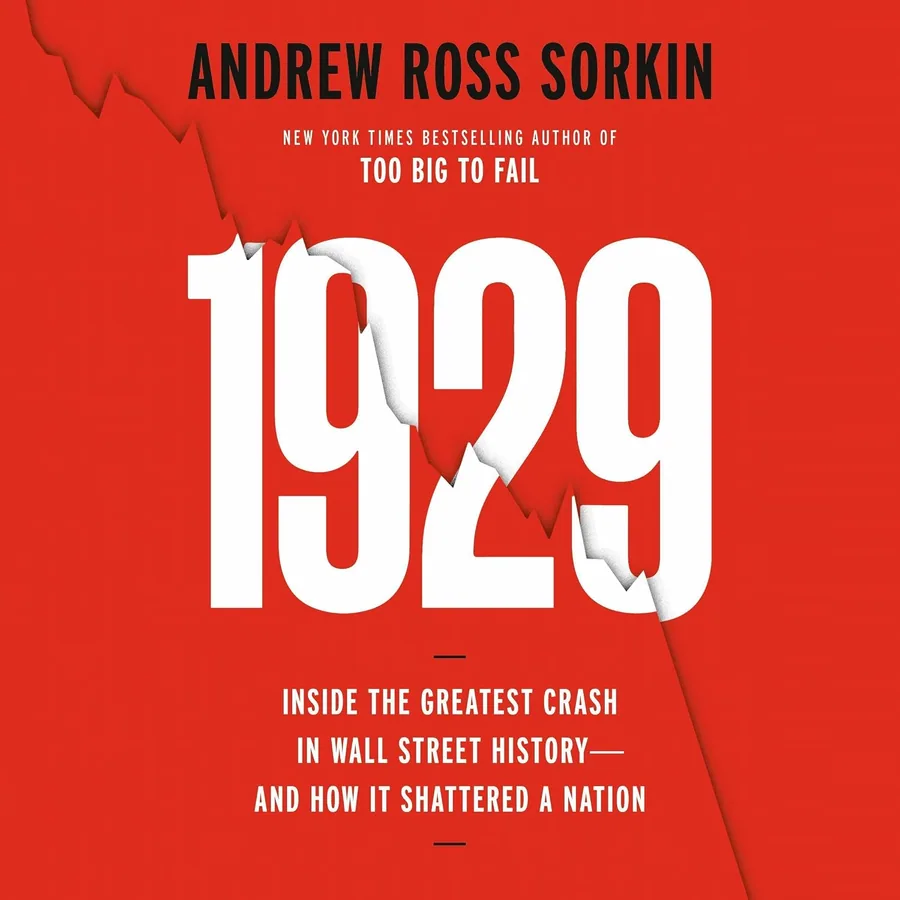
Where to read or listen
- Is there an audiobook of 1929: Inside the Greatest Crash in Wall Street History?
- Yes. 1929: Inside the Greatest Crash in Wall Street History has an Audible audiobook edition, narrated by Andrew Ross Sorkin.Listen free with Audible
We earn from qualifying Amazon purchases.
- How long is the 1929: Inside the Greatest Crash in Wall Street History audiobook?
- The 1929: Inside the Greatest Crash in Wall Street History audiobook runs 13 hr 30 min.
- What formats is 1929: Inside the Greatest Crash in Wall Street History available in?
- On Amazon, 1929: Inside the Greatest Crash in Wall Street History comes as a Kindle ebook, a paperback and a hardcover.
Common questions
- What is 1929: Inside the Greatest Crash in Wall Street History about?
- Sorkin's claim is simple enough to state in one sentence: the crash of 1929 was built by a few dozen men who had the information to see it coming and every reason to keep selling anyway. The book spends 591 pages testing that. It works date by date through the boom year and then hour by hour…
- Is 1929: Inside the Greatest Crash in Wall Street History worth reading?
- We scored 1929: Inside the Greatest Crash in Wall Street History 4.6 out of 5. Andrew Ross Sorkin's 1929 is narrative history that treats the Great Crash as a story about people rather than prices, following the bankers, speculators and politicians who talked themselves into an endless boom. If you read Too Big to Fail, this is the same method turned on…
Advertisement
More like this
Related books

Why Nations Fail: The Origins of Power, Prosperity, and Poverty
Daron Acemoglu and James A. Robinson

The Wager: A Tale of Shipwreck, Mutiny and Murder
David Grann

Team of Rivals: The Political Genius of Abraham Lincoln
Doris Kearns Goodwin

The Warmth of Other Suns: The Epic Story of America's Great Migration
Isabel Wilkerson

The Intelligent Investor: The Definitive Book on Value Investing
Benjamin Graham

Thinking, Fast and Slow
Daniel Kahneman

The Story of Art
E. H. Gombrich

Predictably Irrational
Dan Ariely

The Gales of November: The Untold Story of the Edmund Fitzgerald
John U. Bacon

Sapiens
Yuval Noah Harari